

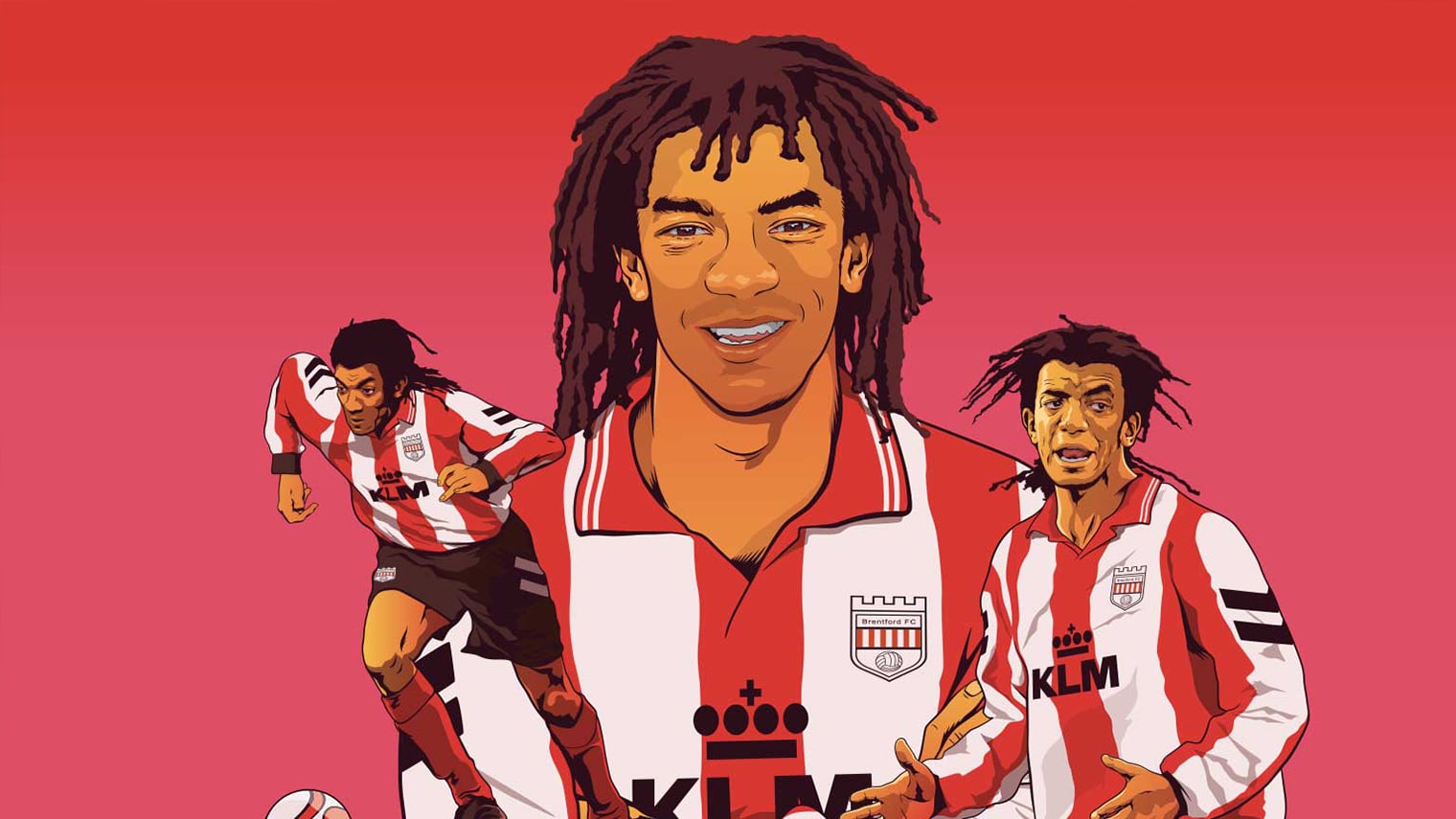
Brought up near Fulham Broadway, a stone’s throw from Stamford Bridge, it was natural that, when Carl Hutchings’ talent was spotted, it was going to be spotted by Chelsea.
He was on the Blues’ books from the age of 11 and was progressing well before he was diagnosed with Osgood-Schlatter disease - a knee issue common in adolescents, and one particularly common among those who play regular sport.
When he returned from spells out injured, things felt different; new players had come in and his enjoyment had waned. So, he decided, after speaking to Brentford forward Craig Ravenscroft - who he had played Sunday football with in the past - to ask to leave Chelsea.
They reluctantly agreed and, after a trial training session with the Bees, he joined as a schoolboy in 1989, before completing a two-year scholarship.
Shortly after David Webb replaced Phil Holder as manager at Griffin Park, following relegation from the First Division in 1992/93, Hutchings was given his first professional contract - and a place in the first team at 18.
“That was an amazing feeling,” he says. “Part of our job as scholars was to run and get the balls if they got kicked over into New Road or Braemar Road and I got to know all the fans, all the characters around the stands in those two years.
“To then run out on the first day of the season and see those fans cheering was amazing.
“Having come from a council estate, with no one in my family really achieving anything significant to act as a role model, so to speak, it was a fantastic achievement for me and all my family were very proud.”
He played almost 100 games across his first two campaigns at Brentford, including 49 in all competitions as Webb’s side reached the Second Division play-offs in 1994/95.
A fast-track route to the first team came with its downsides, though.
“I think most would say they had a love-hate relationship with Webby,” says Hutchings.
“Certainly from 1993 to probably 1995, 1996, he built a team of players that were basically either reserves from other clubs or young players he was giving an opportunity to get in a team much earlier than what they probably would do at other clubs.
“I was always grateful to him for recognising my attributes; he literally put me in on the first day of my first season as a professional at 18 years old. But when you look back, there was a lot of pressure, a lot of fear with the way he managed.
“As a young group of players, we played much more through fear and maybe not to the best of our ability, but to the way that he wanted us to play, which was a winning way, at the end of the day, and got us results.
“He let everyone know, if you're not on your top game, you're going to be off or you're going to be out of the team, so it was up to you to perform.”
"As a young group of players, we played much more through fear and maybe not to the best of our ability, but to the way that he wanted us to play"
With the fear of losing his place in the team hanging over him - and of course the simple desire not to be in the treatment room - Hutchings says, for example, he would attempt to return from an eight-week injury in four or five weeks.
In hindsight, that approach probably contributed somewhat to the ankle issues he had to contend with in 1995/96.
Take a look on Hutchings’ Wikipedia page and you will see it says he rejected a new contract at Brentford in the summer of 1996 in favour of a month-to-month deal.
It soon comes up in conversation. Why was that the case?
“I'd been playing every week and doing really well and I was probably still on the same contract as my first-year pro,” he recalls. “Even though I was younger, some of the boys I was playing with were on three, four times the money I was getting.
“It was a case of, I’ll back myself, keep playing and show you what I can do until you give me something reasonable. I was probably on like 250 quid a week; it wasn’t like I was trying to get a couple of grand a week, I was on 250 quid, probably trying to get 350 quid a week.
“I wasn't doing the month-to-month to move on, but Southend and another club were interested, which I think eventually got the deal done with Brentford once they knew that there was some serious interest.
“I just loved the club and the players. It was home. My house was 20 minutes down the road, so it was more, as long as I can get to training and back and pay for my bills, then I'll do it.
“I'd always had longevity in mind and I thought, when you're doing good enough, the time will come and you'll get the rewards.”
At the end of 1996/97, Brentford had reached the play-offs for the second time in three seasons. And, after a two-legged semi-final win over Bristol City - something Hutchings says is “one of my best memories in football” - they booked a Wembley date with Crewe.
“Going into the final, I had an inner confidence that we were going to really turn them over,” he admits.
“I felt they were the type of team, out of all the teams, we played really well against. We could press, we were aggressive to play against, we had pace all over the pitch and, as a unit, we were all really, really wanting to win for each other.
“I thought we were going to beat them 3-0 or something. How wrong was I?
“I do remember afterwards thinking we'd done absolutely no tactical work going into that game on them whatsoever and I just think, man, what were we thinking? Danny Murphy ran the show.
“Looking back on our team, player for player, with the experience we had, the quality we had, we should have won that game, if we had a little bit more tactical awareness about us. We just went on the pitch knowing what we were going to do, how we were going to play and that was it.
“The minute they started having a little bit more of the ball, we didn't have any sort of awareness of how to stop that.”
“I thought we were going to beat them 3-0 or something. How wrong was I?"
Everything changed after that. Paul Smith, Carl Asaba, Barry Ashby and Brian Statham were sold, while Webb relinquished his role as manager to become chief executive of the club.
Eddie May lasted less than three months as Webb’s managerial successor and, by the time Micky Adams replaced him on 5 November 1997, the Bees were third-bottom of Division Two.
“That's when the team was really stripped,” says Hutchings.
“With no disrespect, some of the players coming in hadn’t played league football. They were coming from Premier League reserve teams and they just didn't know what hit them when they were playing in league games with some really big monsters trying to do you in.
“They were nowhere near; they didn't hit the ground running. We'd had a couple of hangover seasons, but we always we knew he’d turn up or he was going to do something; he was going to win a header, he was going to win a tackle.
“I remember looking around thinking, we’re in trouble here. Week in, week out, that was just one big struggle going out on that pitch just every week. The managers didn't have anything to work with as a squad, but I did feel they were really getting the best out of what they had.”
Less than a year after the play-off defeat, the season after it had ended in relegation, but it brought the best out of Hutchings, who was named Supporters’ Player of the Year for 1997/98.
“The new managers saw what I could offer and gave me that freedom to really show what I could do,” he adds.
Hutchings took the decision to leave the club that summer.
“I'd made that decision that I definitely wanted to go. I felt like I was ready. I'd performed to a certain level and I felt like I need to go and try something new,” he adds.
“I was on holiday and Ron Noades called me up to ask me to come in afterwards. He said he’d double my wages, so I’d be playing a division lower on double the money I’d been on. That would have been a better offer than what I took to go to Bristol City.
“However, I just thought the time had come where I just had to move on. I had to give my career an opportunity, give myself an opportunity to see what I could do at a higher level.
“I was absolutely gutted, though. If we'd got promoted at any time, I probably would have been there my whole career. I loved the club, loved everything about it. It was the best time in my football career.”
After a season and a half at Ashton Gate, Hutchings made a surprise return to Griffin Park on loan. The speed of it all surprised even him.
“I had a meeting with Micky Adams at Brighton that morning,” he explains. “He said he wanted to sign me and wanted to give me a contract once they had avoided relegation, so I trained with them and he said to come back to the stadium to sign.
“On the way, my agent called me and said Brentford were interested. I said if he could get Brentford done, to get it done. Then he called again to see if I’d signed the contract and he said not to, and to come down to Brentford and sign instead, as Noades had said it would be permanent.
“So I had to turn round, go the other way and call Micky and say I wasn’t going to make it, which absolutely ruined my relationship with him. That was only off the back of me loving the club and hoping I could re-establish myself and spend another two, three, four years there.
“But afterwards, I read between the lines. They had a couple of little injuries and I was really just there to fill the gap. There were no real contracts in sight at the end of the season.”
Over the next four seasons, Hutchings played in the Third Division for Exeter, Southend and Leyton Orient, before a season in the Conference with Farnborough. He was retired by the age of 29.
But he was already extremely well-prepared for life after football - a rarity among footballers of his generation - and has not looked back since.
“I set up a property company straight after retirement from football so that's something that's always been my backbone,” he says. “Even as a player, I was buying and selling properties.
“I also set up a couple of different companies: one was a hospitality company where we had nightclubs in central London. I had that for about three, four years straight after football, then half of it closed down and I sold the other half. Then I doubled down on my property stuff and set up a development company, building lots of new build homes.
“And now we're back in the hospitality industry, buying small B&Bs and turning them into boutique hotels, along with workspaces and member spaces within the hotels. Within that, the bar and restaurant elements exist as well. It's very much a busy entrepreneurial life that I lead now!”
The days of taking a bashing in the dressing room for wearing a suit to training, in preparation for a property auction afterwards, paid off for Hutchings, whose story serves as a reminder there can be so much life to be lived once a footballer’s career comes to an end.